The Heap That Remembered
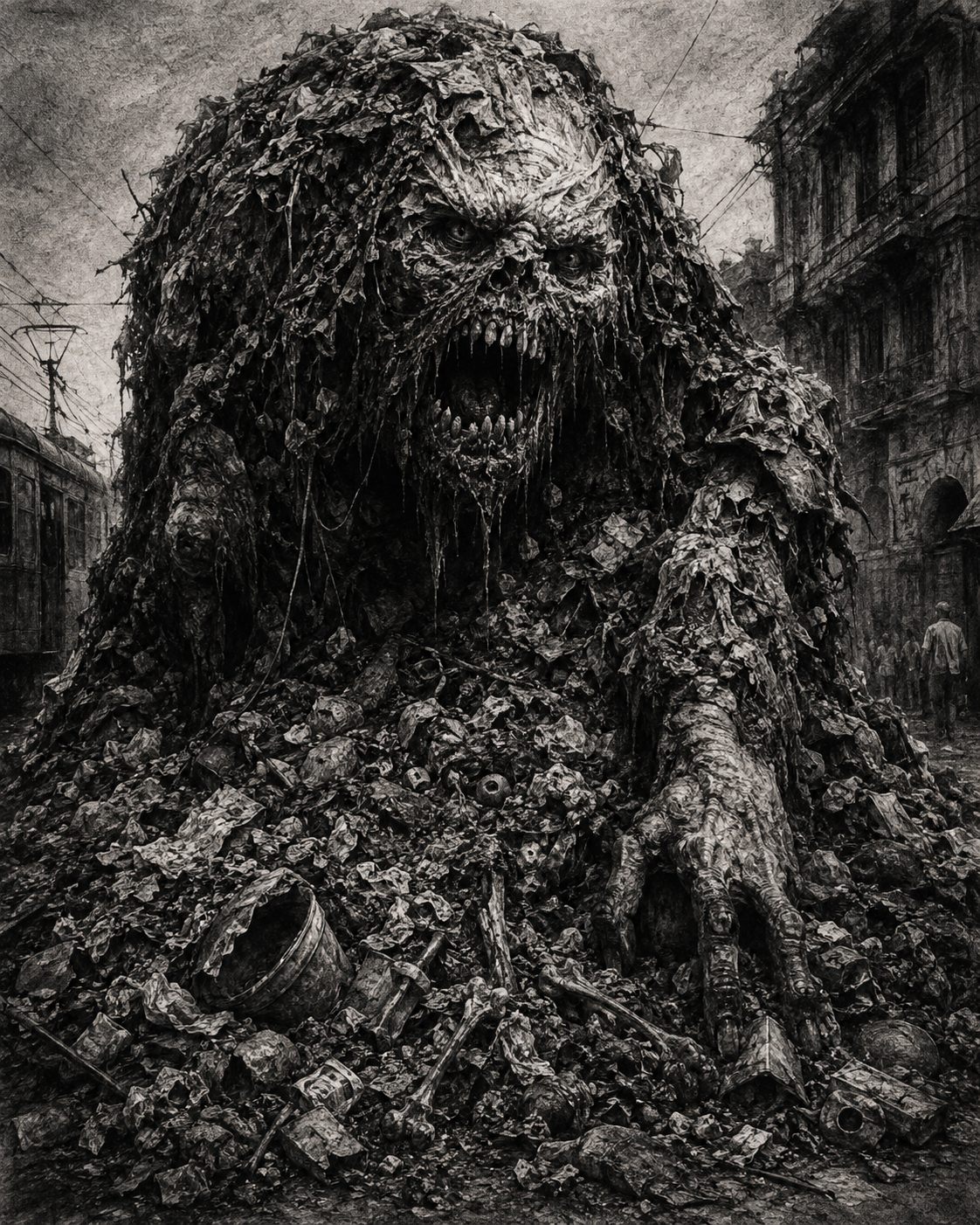
THIS IS A WORK OF FICTION
By seven in the morning the garbage trucks had already begun to sweat.
They came down the broken road beyond the wetlands, each painted with municipal optimism and carrying the private despair of several wards: vegetable peel, school notebooks, dead flowers, cracked plastic buckets, fish scales, bridal thermocol, one blue sofa with its stuffing hanging out like lungs. Crows rode the loads like officials. A tea stall under a tarpaulin did brisk business in overboiled tea, stale biscuits, and political diagnosis. Beyond it rose the garbage mountain, steaming in the weak light, a second city made entirely of what the first city had finished pretending to need.
Nirmal Pal stood beside the weighbridge with a clipboard pressed to his chest, though the clipboard had nothing on it except a curled attendance sheet and three drops of tea.
“Sign now,” said Debu Saha, the contractor, from inside his air-conditioned SUV. He lowered the tinted window halfway, as if Calcutta itself might climb in and ask for a job. “Today is demonstration day. Commissioner’s people may come.”
Nirmal looked at the heap. “Where are your machines?”
Debu smiled. He had the smile of a man who had survived many inquiries by arriving at them with sweets. “You are seeing old world, Palbabu. Machine means noise, diesel, strike, union, tender dispute. This is new science.”
From the tea stall, Bappa laughed. He was nineteen or thirty, depending on the light, with a ragpicker’s wiry body and a film hero’s hair maintained against all civic odds. “New science also gives smell?”
“Work,” Debu snapped.
Bappa raised both hands, palms black. “I am working. Smelling is part of work.”
Nirmal should have disliked him. Instead he felt the usual small ache. Boys like Bappa came to the dump because the city had no room left for their hunger except here, among things that had already lost their owners. Then men like Debu arrived in white shoes and called it waste management, and everyone applauded because respectable people in Kolkata loved cleanliness most when it happened far away from them.
Nirmal’s phone had stopped working the previous week, but he kept touching his shirt pocket for it anyway, an amputee checking weather in a missing hand. His mother’s clinic bills sat folded in his bag, heavy as bricks. Debu knew this. Debu knew everyone’s soft place. That was his actual technology.
The illegal thing arrived in six steel drums.
Not illegal in a dramatic way. Nothing here had a dramatic way. It came wrapped in paperwork, stamped with three departments, imported as “enzymatic remediation concentrate,” and unloaded by men who would later say they could not read English. The drums were small, almost insulting. Each carried a yellow label with no company name, only a warning symbol and the word SUBSTRATE.
“Where is the scientist?” Nirmal asked.
“Science has been done already,” Debu said. “We only have to pour.”
A woman emerged from the second vehicle, tying her hair back. She wore a cotton kurta, rubber boots, and an expression of active regret.
“This is Dr. Ira Sen,” Debu said. “Consultant.”
“I am not responsible for field deployment,” she said before anyone could accuse her.
“Of course,” Debu said cheerfully. “Nobody is responsible. That is how modern India becomes efficient.”
Nirmal almost smiled. Then he noticed the crows had gone quiet.
They poured the first drum into a trench cut into the side of the heap. The liquid inside was grey, neither thick nor thin, with a faint shine like fish skin. It did not splash. It spread.
At first nothing happened. The labourers shifted, disappointed. Bappa whistled. Debu checked his watch in a theatrical way.
Then the garbage sighed.
Not settled. Not collapsed. Sighed.
A patch of black plastic wrinkled inward. Banana stems softened into brown lace. A torn textbook, swollen by rain, shivered page by page until the diagrams of plant cells became a transparent smear. The smell changed from rot to something oddly clean, like wet stone in an old courtyard after the first rain.
Debu clapped once. “See?”
Nirmal wrote in his inspection sheet: visible reduction observed at surface level.
He did not write: heap breathed.
By noon, a bite had appeared in the garbage mountain. Not a large bite, but unmistakable, a crescent scooped from the slope as neatly as if an invisible animal had fed there. Men came from the municipality, posed, praised innovation, complained about traffic, left before lunch. Debu distributed biryani packets. Dr. Sen did not eat.
Bappa brought Nirmal a folded page from the half-digested textbook.
“Keep,” he said. “Your department likes paper.”
On the page, an exercise in English grammar remained legible.
Identify the object in the sentence.
Nirmal folded it and put it in his pocket for no reason he could explain.
That evening, when he reached his mother’s room in their damp flat near Behala, she was sitting on the edge of the bed, holding his father’s old shaving brush.
“I found this under the trunk,” she said.
His father had died twelve years ago of a stroke after spending forty years repairing clocks, radios, and other stubborn machines. He had left behind tins of screws, unpaid cooperative dues, and a notebook in which he had written, in tiny Bengali letters, every rupee ever borrowed.
“You should throw it,” Nirmal said.
His mother looked up sharply. “Throw your father?”
“No, Ma. The brush.”
“That is what you said.”
Her memory had begun to fold in strange places. Some days she forgot lunch. Some days she remembered, with cruel freshness, a neighbour’s insult from 1987. Nirmal had learned that memory was not a cupboard. It was a pond. Things sank, swelled, floated up green.
At nine, Debu called from an unknown number.
“Tomorrow early. Bring all records of legacy dumping. Old site maps, burial complaints, encroachment files. We need to show before-after.”
“Why burial complaints?”
“Arrey, Palbabu, everything is mixed there. Waste, cow bones, temple leftovers, hospital scraps from old days. Your signature needed.”
The line crackled. Behind Debu’s voice came another sound, soft and granular, like rice being poured endlessly into a steel bowl.
On the third day, the heap had changed shape.
Not merely reduced. It had arranged itself. Plastic rose in veins. Cloth gathered in ridges. Paper lay in pale nests. Bones, animal mostly, whitened in a neat crescent at the foot of the slope. Idols from last year’s puja, clay faces dissolved by immersion and neglect, had collected together, their painted eyes staring from mud.
Bappa stood beside them, unusually quiet.
“You did this?” Nirmal asked.
“Me? I only steal useful things, dada. This is educated work.”
Dr. Sen crouched near the bones, holding a glass vial. The grey shine moved over a goat skull and withdrew, leaving it polished.
“It is not consuming uniformly,” she said.
Debu frowned. “Meaning?”
“It is classifying first.”
“Good. Smart.”
“No,” she said. “It was not designed to classify.”
Nirmal asked, “What was it designed to do?”
She looked at Debu, then at the heap. “Break polymer chains. Cellulose. Organic matter. Some metals. It uses molecular recognition. A self-replicating cleaning swarm.”
“Self-replicating?” Nirmal repeated.
“Controlled,” Debu said quickly.
Dr. Sen did not agree. She did not disagree. In government-adjacent work, silence had more salary grades than speech.
At noon a labourer shouted from the southern slope. They found him kneeling beside a hollow the swarm had opened. Inside were books. Not loose pages, not wet pulp. Books, standing upright in rows as if someone had built a small library inside the garbage.
School primers. Account ledgers. Religious calendars. A red diary. A college physics guide. Children’s exercise books with careful handwriting. All cleaned of slime, covers bright, pages dry.
On top lay a notebook with a blue cloth spine.
Nirmal knew it before he touched it.
His father’s debt notebook.
For several seconds he could not breathe. He had burned that notebook after the funeral, ashamed by the names, the smallness of the amounts, the evidence of a household always one illness from humiliation. He had burned it in a broken flowerpot on the balcony while his mother slept. The ash had blown into the lane. He remembered because a neighbour had complained that black flakes were falling on drying clothes.
And now here it was, clean and whole, on a dump beyond the wetlands.
Bappa watched his face. “Your thing?”
“No.”
The lie came so fast it frightened him.
Dr. Sen noticed. “Mr. Pal?”
He opened the notebook. Page one listed Debts to be repaid before Durga Puja, 2009. His father’s hand. Beneath it, in a newer line that had never existed, appeared another sentence, written in the same tiny script.
Object identifies subject by what it refuses to discard.
Nirmal shut the book.
That night his mother did not recognize him for nearly twenty minutes.
She called him by his father’s name and asked why the ceiling fan had stopped, though it was turning. She asked if the boy had come home.
“What boy?” Nirmal said.
She looked at him with annoyance, almost her old self. “Your brother.”
Nirmal had no brother.
He said this carefully, the way one speaks near an open drain.
His mother began to cry. Not loudly. She folded inward, pressing the shaving brush to her chest. “You also threw him.”
The next morning, Nirmal went to Dr. Sen before Debu arrived.
“What exactly is happening?”
They stood behind the weighbridge, where the tea seller was rinsing glasses in a bucket that had seen too much civilization.
Dr. Sen’s eyes were red. “It is building a taxonomy.”
“A what?”
“A system of categories. But not ours. It began with chemical composition. Then function. Then human association. It has learned from the heap.”
“The heap teaches?”
“The heap is Calcutta’s autobiography, Mr. Pal. Food, medicine, exam papers, idols, bank notices, hair, blood, broken toys, love letters, legal evidence, dead pets. Every household sends a little confession here in plastic bags.”
Nirmal stared at the garbage mountain, where a faint grey ripple moved under the surface.
“You said controlled.”
“I said designed. Designed is not controlled. Ask any parent.”
He almost laughed. It came out as a cough.
She lowered her voice. “Debu added municipal archive waste yesterday. Old files. Burial disputes. Missing-person complaints. Demolition records. The swarm is correlating matter with memory.”
“Memory is not matter.”
Dr. Sen looked at him with tired pity. “Then why do you keep your father’s brush?”
By afternoon, the first human bone surfaced.
A finger bone, small and brown, wearing a ring of green glass.
Debu ordered it covered. Bappa refused.
“Police,” Bappa said.
Debu stepped close enough for his perfume to fight the dump and lose. “You know how many small theft cases are pending against boys here? One call.”
Bappa’s face hardened, then emptied. He looked very young.
Nirmal heard himself say, “We record it.”
Debu turned. “Palbabu, your mother’s clinic bill cleared yet?”
There it was, placed on the ground between them like a knife.
Nirmal imagined his mother in the government ward, waiting beneath a fan that moved hot air from one bed to another. He imagined Debu’s envelope. He imagined the finger bone.
“Record it,” he said again.
The swarm moved before anyone else did.
The grey shine climbed from the trench, crossed the mud in a sheet thinner than water, and surrounded the bone. It did not consume it. It lifted it.
Not physically, exactly. The bone rose inside a little column of dust, paper fibre, powdered clay, and glitter. Around it gathered other things: a child’s red hair clip, a torn bus ticket, two rusted safety pins, a rectangle of blue cloth, a page from an old ration card.
Dr. Sen whispered, “It is reconstructing context.”
The dust column trembled. For a second, in the heat above the garbage, Nirmal saw the outline of a hand. Small fingers. The green ring on one.
Then it fell apart.
Bappa made a sound like a kicked dog. “That cloth,” he said. “My sister had frock like that.”
Debu slapped him.
It was not a hard slap. It was worse: administrative. The kind delivered by a man confident the world would file it under necessary management.
Nirmal stepped between them.
“Enough.”
Debu laughed. “You have become hero? At dump?”
The sky had gone the colour of old aluminium. A storm was arranging itself over the wetlands. The heap clicked softly. Thousands of small dry clicks, like seeds in a tin.
Dr. Sen grabbed Nirmal’s arm. “We have to stop feeding it.”
“How?”
“Salt. Heat. Acid. Anything that disrupts the suspension. The control drums are in his vehicle.”
Debu heard. He began backing toward the SUV.
Bappa ran first. Debu shouted. Two labourers moved uncertainly, then did what labourers are paid to do when rich men panic: they got out of the way.
Nirmal followed Bappa through mud and torn plastic. Rain began in fat, widely spaced drops. Debu reached the SUV, opened the rear door, and pulled out a black case.
“Move,” he said.
Bappa came at him like a thrown stick. Debu swung the case. It caught the boy on the shoulder. He fell.
The case opened. Inside were three smaller canisters marked INHIBITOR.
And beneath them, wrapped in plastic, were bones.
Not old bones from the heap. Clean bones. Thin, brown, carefully packed.
Dr. Sen arrived behind Nirmal and stopped dead.
Debu’s face changed. Not guilt. Calculation interrupted.
“What is this?” Nirmal said.
“Animal samples.”
The swarm answered.
It poured from the ground in a grey ring around the SUV. The packed bones shook in their plastic. From the heap came a low movement, not a sound but an intention travelling through matter. The books in their hollow fluttered. Clay idols shifted. The crescent of bones clicked.
One by one, things began moving toward Debu.
A woman’s sandal. A hospital wristband. A school slate. A length of sari. A cracked tooth. A little brass key. Paper, hair, threads, ash, photographs with faces blurred by rain. They crawled, dragged, slid, assembled at his feet.
Debu tried to step back, but the grey ring held.
Nirmal understood then with a clarity that made the world appear foolishly bright. Debu had not brought the swarm only to shrink garbage. He had brought it to erase old dumps before land transfer, before apartments, before questions. Old bodies were bad for business. The city had always known the poor disappeared into drains, stations, worksites, clinics, marriages, and contractor accounts. The swarm had simply read the footnotes.
But the heap had read Nirmal too.
From the library hollow, his father’s notebook opened in the wind. Pages tore free and flew across the mud, sticking to his shirt, his face, his hands. Not debt pages now. Other pages. New pages.
Names he did not know.
And one he did.
Milan Pal.
His mother’s lost boy.
Memory came without mercy.
Nirmal was six. A fever summer. A baby crying in the next room. His mother asleep from exhaustion. His father gone to buy medicine on credit. Nirmal, angry because the baby had broken his red pencil, had carried the crying bundle to the balcony to show him crows. The cloth had slipped from his small arms. Not far. Not down to the street. Into the open municipal vat below, piled high because the conservancy workers were on strike.
He had screamed. People had come. The vat had been emptied badly, hurriedly. A bundle found, then not found, then officially never there. His mother’s mind had placed a board over the hole. His father had grown silent. Nirmal had become an only child because the alternative was a house that could not continue.
He had forgotten because everyone had helped him.
The swarm had not.
Debu was shouting now. “Use the inhibitor! Palbabu! For your mother! For everyone!”
Dr. Sen held one canister. Her hands shook. “If we release it, we may stop the swarm. But it will dissolve the reconstructions.”
Bappa, sitting in mud, said, “My sister?”
No one answered.
The ring tightened around Debu’s shoes. Objects climbed his trousers. A thread, a tooth, a page, a child’s clip. They did not tear him. They named him.
Nirmal picked up the second canister.
His mother needed care. The site needed containment. The swarm could spread through drains, monsoon water, markets, homes. It could enter trunks, cupboards, mouths. It could decide a living city was only waste arranged briefly upright.
He looked at the heap.
It looked back with everything Calcutta had thrown away.
Then Nirmal did the most practical thing he had ever done. He opened the canister and poured the inhibitor not on the swarm, but into the trench where the unused drums still leaked.
Dr. Sen understood. She poured hers beside him.
The grey shine convulsed. The heap groaned. From the SUV came Debu’s scream, short and indignant, like a man protesting a bill.
Rain fell hard. Salt and acid stung the mud. The swarm withdrew from the open ground, shrinking, smoking, carrying its assembled relics back into the mountain. It left Debu alive but kneeling, covered from throat to ankle in grey dust and labels of paper. On his forehead, written in his own sweat and some patient powder, was one word.
SUBSTRATE.
The police came late, because police came late to places where votes were counted but people were not.
By then Bappa had found the blue cloth again. Dr. Sen had locked the remaining drums. Nirmal had put his father’s notebook in his bag.
At home, his mother was awake.
“Where were you?” she asked.
“At work.”
“Did you bring him?”
Nirmal sat beside her. The room smelled of medicine, damp plaster, and old talcum powder. He opened the notebook to the page that had not existed. Milan’s name lay there in his father’s handwriting, followed by no accusation, no forgiveness, only a date.
His mother touched the page.
Outside, rainwater ran along the lane, carrying tea leaves, incense ash, a dead cockroach, flower petals, and one small flake of grey that paused at the drain as if listening.
Then it moved on, taking with it nothing that had not already been offered.